
Every organization adopting AI eventually reaches the same question: when something goes wrong, who pays?
The answer is spread across an organization’s insurance policies, its contracts with technology providers, its internal governance, and the judgment of the people overseeing each system. Most leadership teams have not traced that chain from end to end. Many are discovering that it has gaps.
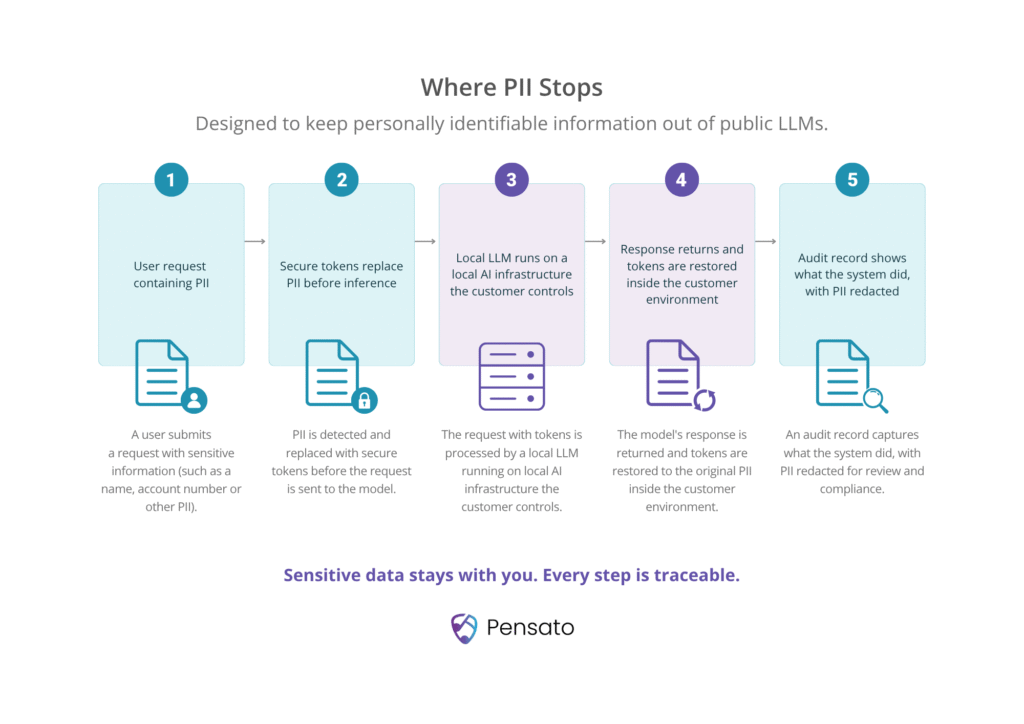
Pensato’s secure AI is built for regulated organizations: a local LLM runs on local AI infrastructure the customer controls, and secure tokens stand in for PII (Personally Identifiable Information), such as names, Social Security numbers, and account numbers, before any model sees it. Financial accountability for AI is arriving faster than most organizations expect, and the organizations that handle it best will be the ones that can show, with evidence, what their systems were allowed to do.
AI Risk Is Now a Financial Question
Organizations have long managed technology risk with four things working together: security controls, contractual protections, insurance, and operational oversight. AI strains all four. Its outputs shape decisions, generates content, and touches sensitive information. Increasingly, it initiates actions across connected systems.
Consider an AI-assisted workflow that sends a customer an inaccurate communication, exposes confidential information, or makes a recommendation that leads to a financial loss. Responsibility could sit with the organization that deployed the system, the vendor that supplied it, the employees who oversaw it, or another service provider in the chain. Often it sits with several at once.
Insurance may respond, but only as far as the policy language, the circumstances of the loss, and the exclusions allow. Leaders should not assume that an existing cyber, professional liability, or general liability policy covers every AI-related incident. Increasingly, it does not.
The Insurance Market Is Drawing Lines
For years, AI exposure sat quietly inside existing policies, covered by default because no one had written it out. That period is ending. Carriers are now moving to state their position in the policy itself, and three developments are worth knowing.
- General Liability: In January 2026, the Insurance Services Office (ISO) introduced generative AI exclusion endorsements for commercial general liability forms, and carriers have been attaching them at renewal.
- Professional And Management Liability: R. Berkley has filed an “absolute” AI exclusion designed to remove coverage across D&O, E&O, and fiduciary lines for claims connected to AI use.
- Cyber: Cyber policies generally respond to data breaches, not to harmful AI output where no breach occurred, and carriers are reportedly targeting AI in cyber renewals as well.
In some of this wording, the trigger is any connection to AI, not how much of the work AI performed. A claim with a thin link to AI can still be contested.
Claims are rising alongside the exclusions. Gallagher Re reports that US generative AI lawsuits grew 978% between 2021 and 2025.
The market is not moving in one direction. Some specialty insurers have said they will not adopt the ISO exclusions and are writing affirmative AI coverage. Standalone AI liability policies now exist, with reported limits between $2 million and $50 million, and they address losses such as business interruption from AI-driven failures, incorrect funds transfers, incident response and regulatory costs, and third-party harm from AI outputs.
Coverage is also fragmenting across cyber, technology E&O, D&O, and other lines. The only reliable way to know where you stand is to read each policy for its AI language.
Key Takeaway: Standard commercial policies are adding AI exclusions at renewal. Confirm in writing what each of your policies covers for AI, and close any gap with a specialty policy or with controls that reduce the exposure.
Underwriting Is Becoming Another Form of Governance
Regulators and industry frameworks already encourage organizations to establish oversight, manage risk, and document how AI is used. Underwriting adds a different kind of accountability, which shows up in coverage terms and price.
When an insurer evaluates a risk, it looks at the controls an organization has in place to reduce the likelihood and severity of a loss. For AI, the relevant questions are: Which systems are in use? What information can they reach? Who approves their deployment? How is their behavior monitored?
Specialty AI insurers already describe underwriting each agent individually, based on its deployment context, permissions, data access, usage volume, and the people who interact with it. Insurers may ask these questions of any organization as AI underwriting practices mature. They are not legal requirements, but they shape business decisions through the availability of coverage, exclusions, premiums, and contractual conditions.
Organizations that keep clear records of their AI use and oversight will find it easier to explain their approach. That does not guarantee coverage or favorable pricing, but it does make the approach possible to evaluate.
From Policy to Proof
Compliance sets the floor. Responsible AI governance also requires an organization to decide what its systems are meant to do, translate those boundaries into instructions, permissions, and approval requirements, and test that the systems follow them.
Documentation connects that intent to practice. An organization should be able to show what it expected a system to do, what safeguards it set, how it tested them, and what happened when the system did not behave as intended. When an insurer, customer, or regulator asks how AI risk is managed, that record is the answer.
The Standard To Meet: Responsible AI governance is evidence that the organization understood its risks, set boundaries, tested its approach, and acted when problems appeared. A policy states intent. Evidence shows it was carried out.
Architecture Is Part of the Answer
Governance that depends entirely on people remembering the rules will eventually fail. That is why Pensato treats architecture as part of risk management. Where a system is built to prevent a failure, there is less to insure, less to explain, and less to dispute.
- Local AI: Inference runs on infrastructure the customer controls, on-premises or inside their own environment, so sensitive work does not depend on a public service.
- Local LLM: The model itself runs locally. Prompts and completions are designed not to travel through public AI APIs.
- Secure Tokens: Sensitive values are replaced with reversible tokens before inference, and the mapping stays inside the customer’s environment. The model keeps its context without seeing the underlying PII.
- Auditable Records: Source traceability and audit logs show how information was accessed, processed, and used, with PII redacted.
 Industry reporting indicates that over 40% of organizations have experienced AI-related privacy incidents. Keeping PII from reaching a model in the first place is a more dependable control than explaining afterward why it did.
Insurers already know the language of data loss prevention (DLP). Cyber insurers often look for DLP capabilities alongside controls such as endpoint detection and email security, because DLP limits how much sensitive data can leave an organization. AI adds a new route for that loss: the prompt. Data sent to a public model has left the organization’s control. Pensato’s secure AI applies the DLP principle by design. Secure tokens replace PII before any model sees it, and a local LLM on local AI infrastructure keeps prompts and responses inside the customer’s environment. That gives an underwriter a plain answer to a plain question: what sensitive data can reach a model?
No architecture removes risk. A well-built one narrows it and makes what remains visible.
Key Takeaway: Pensato is the answer to this gap. Its secure AI keeps PII away from models through secure tokens, runs a local LLM on local AI infrastructure, and records what the system did. That means less exposure to insure and more evidence to show an insurer.
Indemnification Deserves a Closer Look
Insurance is one part of financial accountability. Contracts with AI vendors and service providers are the other.
An indemnification provision determines when one party agrees to protect another against specified claims or losses. These provisions matter most when AI systems depend on third-party models, software platforms, data sources, or automated services, because the chain of responsibility grows longer with every dependency.
Recent events show how exposure moves through that chain. This month, Credit Mutuel Arkea, a French banking group, reported that attackers reached it through a service provider’s platform and then moved money out through the bank’s own account. Reported losses ran to roughly 100 million euros or more. It was not an AI incident. It is a clear example of a question every AI deployment raises: when a failure arrives through a third party, who answers for it?
Leadership teams should read their agreements closely. A vendor may protect a customer against certain intellectual property claims while excluding losses tied to how the customer uses the technology. Other agreements cap liability, attach conditions to indemnification, or assign specific responsibilities to the deploying organization. The presence of an indemnification clause does not mean every AI-related loss is covered.
Review these provisions with legal counsel, and consider how contractual responsibilities line up with insurance policies and internal controls.
Key Takeaway: Vendor indemnification and insurance policies work together. Review both with counsel, and confirm that every AI-related loss has a clear owner.
Questions Leaders Should Ask Now
Organizations do not need to wait for a renewal or a new regulation to examine their AI exposure. Five questions are a practical place to begin.
- Do we know which AI tools and automated workflows are in use across the organization?
- Have we identified where AI interacts with confidential, personal, or regulated information?
- Have we reviewed our insurance coverage and vendor agreements for AI-related exposures?
- Is someone accountable for approving AI systems and monitoring their use?
- Can we produce evidence of the controls and decisions that support our governance practices?
These questions tie technology decisions to financial accountability and executive oversight. Legal, finance, risk management, operations, and business leadership each have a role in answering them.
Where Pensato Stands
Organizations must understand the risks technology creates, the responsibilities they accept, and the evidence they can produce when their decisions are examined.
Pensato’s secure AI is built for that standard: a local LLM, local AI deployment, and secure tokens that protect PII, with audit records of what the system did. Regulated organizations get AI workflows designed to stand up to questions from an insurer, a regulator, or a board.
Start with your insurance policies. Read them for AI exclusions and endorsements, then compare what they say against the AI systems your teams use today and the indemnification terms in your vendor agreements.
Talk To Us: Pensato’s technology is the safeguard. Varium’s Repertoire and AI governance consulting are the guide.
- Pensato: secure AI with a local LLM, local AI, and secure tokens that keep PII out of public LLMs
- Varium: Repertoire and governance consulting that lead your teams through safe AI workflows
Contact us to review your AI exposure before your next renewal.
Sources
- Insurance Business, “Why your clients probably aren’t covered for AI”
- Fenwick, “The End of Silent AI?”
- Shumaker, Loop and Kendrick, “The New AI Coverage Fight”
- Jolt Journal, “AI Liability Insurance: What the New AI Exclusions Mean”
- Beinsure, “Credit Mutuel Arkea cyberattack”