
A mortgage servicing employee reconstructing a borrower’s account history works across loan documents, payment records, correspondence, servicing notes, and internal procedures. Some of those records sit in different systems, and some arrived through a servicing transfer. Finding the information is only the first movement of the task, because the employee must also decide which records are current, reconcile any inconsistencies, and settle on the right action.
Secure AI can take on much of the assembly work, and the architecture behind it determines how well borrower information stays protected.
Loan files carry sensitive borrower information, including Social Security numbers, income documentation, bank account details, and property addresses. Pensato protects sensitive identifiers through secure tokenization before information reaches an AI model, while the token vault remains within infrastructure your organization controls.
Pensato takes a local-first approach to AI. Analysis can occur on a local LLM within your organization’s environment or, when organizational policy permits, use an approved external model with protected information. Original sensitive identifiers remain local, giving your organization greater control over how borrower information is processed and protected.
Mortgage Servicing Is a Natural Fit for AI
Mortgage servicing produces records at every stage of a loan’s life, including payments, escrow, borrower communications, loss mitigation, default management, and investor requirements. Most of what an employee needs already exists in those records, and the work is finding it quickly and reading it in context. Traditional document management systems store and retrieve files. AI adds the ability to read across them together, spot relationships between records, summarize long histories, and answer questions in plain language.
With that capability, an employee can request a preliminary account history that links each statement to its supporting record. The employee reviews it, applies professional judgment, and chooses the next steps. AI sets the tempo for assembling the information, and the servicing specialist conducts the decision.
How a Hardship Request Moves Through a Secure AI-Assisted Workflow
Consider a servicing specialist at a company that recently acquired servicing rights to a portfolio. A borrower writes in after losing a job, asks about payment relief, and mentions that the prior servicer had already agreed to a repayment plan.
The following illustration traces the request through a secure AI-assisted workflow, showing where sensitive borrower information is protected, how organizational policy determines whether inference occurs locally or in the cloud, and how the resulting information returns to the specialist for review.
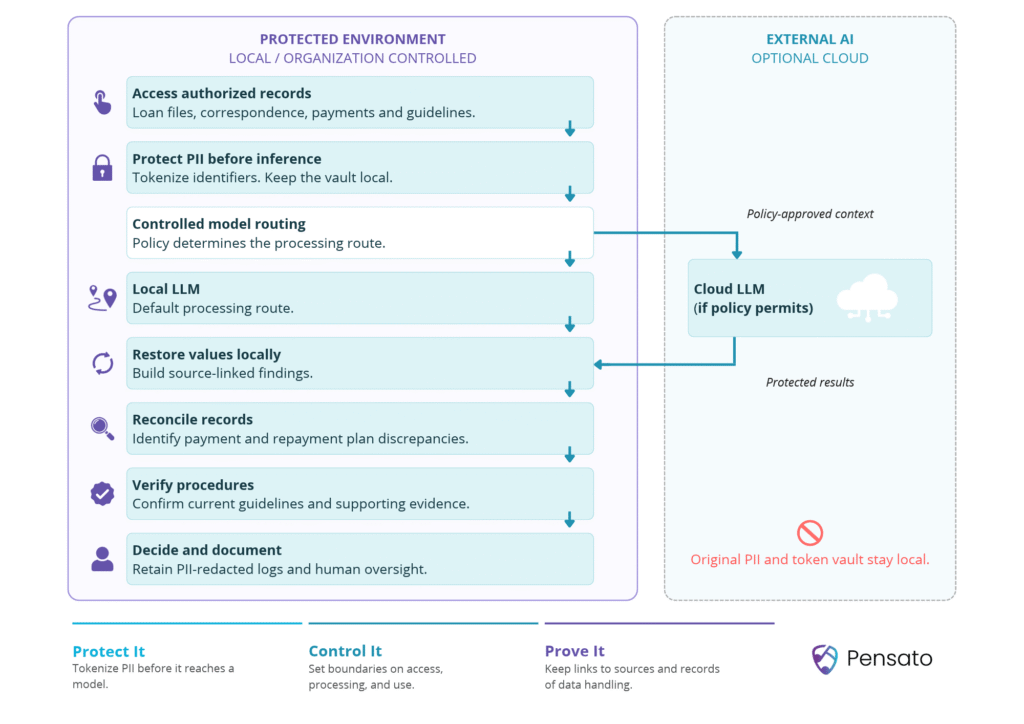
1. Start with the records you are authorized to see. The specialist opens the borrower’s file, and the AI works from the documents the specialist’s role permits: the boarded loan file, the prior servicer’s notes, two years of correspondence, the payment history, and the applicable investor guidelines. Access boundaries are set before the first question is asked, so every answer draws only on records the specialist could open anyway.
2. Protect the PII before inference. The Social Security number, bank account, and property address become secure tokens such as [SSN_1], [ACCT_1], and [ADDRESS_1], while the token vault remains inside your environment. Depending on organizational policy, the protected information can be processed by a local LLM or routed to an approved external model. Original identifiers remain local, and authorized values are restored within the protected environment after analysis.
3. Receive a preliminary account history with sources attached. The selected LLM assembles a timeline using the permitted information: the transfer date, the last recorded payment, the borrower’s hardship letter, the prior servicer’s reply, and a reference to a repayment plan. The results are returned to the protected environment, where findings are connected to their supporting documents and passages for the specialist to verify.
4. Reconcile what the records say. The timeline shows that the prior servicer’s payment history lists the April payment as received, while the new servicing system shows it as missing. It also shows that a letter mentions a repayment plan with no matching plan on the boarded loan. The specialist now has two specific items to investigate and can request the missing plan documentation from the prior servicer with the supporting letter in hand.
5. Check the procedure against its evidence. The specialist asks which procedure applies to a hardship request on this loan. The answer cites an investor guideline section along with its effective date, and that date reveals the first passage returned comes from a superseded version. The specialist opens the current version, confirms it applies to this loan, and moves forward knowing the guidance is current.
6. Decide, and keep the record. The specialist chooses the next steps, and the data-handling activity from the session is logged with PII redacted. When quality control or audit teams later ask how the information was processed, the record is there, and every AI-assisted finding connects back to the underlying documents.
In one sitting, the specialist covered research that normally spans several systems and several folders of correspondence. Every finding carried its source, every identifier stayed protected, and the final judgment stayed with the person accountable for the outcome. Source traceability gives employees a strong foundation for that judgment, and reviewing the cited passages remains part of the job.
Where Else AI Can Create Value in Mortgage Servicing
The pattern fits servicing transfers, where incoming records need to be reviewed, reconciled, and folded into existing operations, and it fits policy and guideline research across large document libraries. It also supports default management and loss mitigation, where complex histories need organizing before qualified staff evaluate them, and quality control and audit preparation, where teams locate supporting records and spot discrepancies. In each case, AI improves the work that happens before a consequential decision, and people make the decision.
Preparing for the Next Stage of Mortgage AI Governance
As AI moves into core mortgage operations, existing governance practices extend to cover acceptable uses, access boundaries, provider evaluation, accountability, and evidence of how AI systems operate.
MISMO’s FRAME initiative reflects the industry’s growing attention to structured AI adoption and risk management. A policy can state that sensitive borrower information must stay out of unauthorized AI services, and technical safeguards then put that policy into effect and show whether it is working. Industry reporting indicates over 40% of organizations have experienced AI-related privacy incidents, which is why protecting data before it reaches a model matters so much.
Where Pensato Fits
Pensato builds secure AI for organizations that handle sensitive and regulated documents, guided by three principles. Protect It reduces exposure by tokenizing PII before it reaches a model. Control It sets boundaries around how information is accessed, processed, and used. Prove It maintains links to supporting documents and records of data-handling activity so your organization can review how information was used.
Pensato is a MISMO Associate Champion and takes part in the AI Community of Practice and the Servicing Transfers Development Workgroup. That involvement keeps our work tuned to the industry’s operational challenges and evolving expectations for AI governance.
See It for Yourself
Mortgage servicers can have information that is both more useful and well protected. Secure tokenization, local-first AI infrastructure, and policy-controlled model routing help your team uncover the full story within a loan file while protecting sensitive borrower information and maintaining connections to supporting evidence. Research moves more efficiently, and accountability stays with the servicing specialist.
Explore Pensato’s secure AI approach for mortgage lending and servicing to learn how document protection, controlled processing, and source traceability can support your organization.
MISMO members can take Varium’s AI Governance Assessment, built around the MISMO FRAME, at no cost; access is password protected, and you can begin here.
Let us help you identify opportunities and considerations for responsible adoption.