
A decade ago, Stanford researchers ran a study that should bug anyone who writes about AI. They gave people the same crime stats for a made-up city, then changed one word. Some readers heard crime described as a beast preying on the city. Others heard it called a virus infecting it. Then everyone was asked what the city should do.
The beast group wanted enforcement and cages. The virus group wanted diagnosis and reform. The gap was bigger than the gap between political parties in that same study. And when people were asked what changed their mind, almost nobody blamed the word. About 3% even noticed it.
One word, quietly deciding what gets built. Now look at the word we’ve all agreed to use for AI: harness.
“Harness”
It’s everywhere. The leading open-source eval framework has “harness” in its name. “Agent harness” is the term of art at every major lab. And then there’s the marketing cliché sitting on top of it all: harness the power of AI.
The word comes from tack, straps that let you extract a draft animal’s strength for your own cart. Every other sense of “harness” tells the same story. A safety harness assumes you’re about to fall. It restrains, it doesn’t enable. Nobody flies on a safety harness. A test harness just holds whatever you’re testing still so you can poke at it. In every case, the harness is worn by the subject and used by the operator. The subject is either a power source or a hazard. Never a performer.
“Rigging”
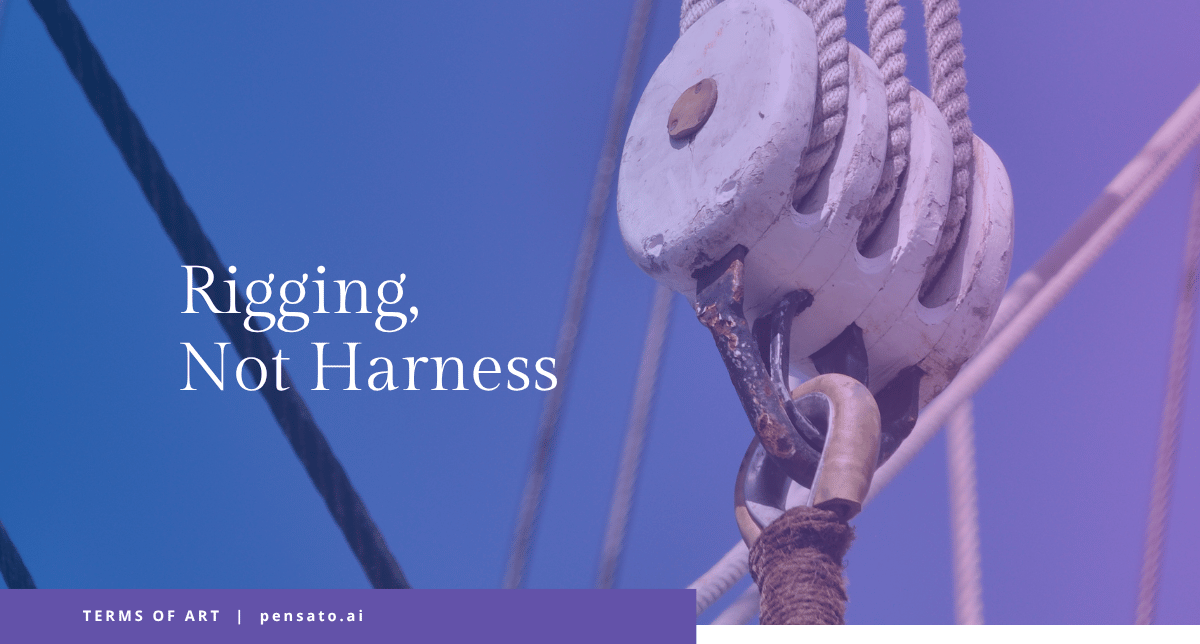
There’s a better word sitting right next to it: rigging.
Rigging comes from sailing, fitting a ship with the masts and lines it needs to actually sail. Theater borrowed the word for the fly systems above a stage: the lines, pulleys, and counterweights that let scenery, lights, and people fly. When Peter Pan first flew across a Broadway stage in 1954, it was because a rigger named Peter Foy built a system that could safely swoop a grown adult over an audience, eight shows a week.
Rigging is the mirror image of a harness. It’s structure built around the performance, in service of the performer. Here’s the part that surprises people: rigging is more safety-engineered than a harness, not less. Modern entertainment rigging has certification programs, safety margins several times the working load, and inspection logs. All that discipline exists so the performer can fly. Safety isn’t the absence of the stunt. It’s what makes the stunt possible.
That’s basically the idea behind “Safety-II” thinking in safety science: safety isn’t the absence of accidents, it’s a system’s capacity to succeed under changing conditions. Aircraft carriers and air traffic control run on the same logic. Safety and the mission aren’t in tension, they’re the same job.
Why the Word Matters
Say “harness,” and your roadmap fills up with harness-shaped work: fixtures that hold the model still, guardrails that subtract capability and call it safety, sandboxes with no exit plan. Say “rigging,” and different questions become unavoidable. Is this line rated, and by whom? Where’s the inspection log? Does this fail loud, or silent? What would it take to certify this for a heavier load?
You can’t keep asking “is the line rated?” without eventually building the process that rates it. The word drags the engineering behind it.
One AI platform said something interesting this year: as models get more and more similar in raw capability, it’s increasingly the harness, the scaffolding around the model, that decides how well the whole thing performs. Swap in the better word and the point gets sharper. The structure around the model is where you win on capability and safety both. That’s not really a harness idea. That’s a rigging idea.
A Quick Test
Here’s the test we use at Pensato for every new control or guardrail, and the one I’d hand to any team building with AI.
Does this let the system do more, safely, or does it just restrict?
If it enables: that’s rigging. Rate the line, log the inspection, make failure loud, and let it fly.
If it only restricts: that’s a harness. Either redesign it as a certification path (“not rated for that yet, here’s how it gets rated”) or write down why the restraint is permanent. A restraint with no path to flight should have to explain itself.
Buyers in regulated industries don’t actually want their AI in a cage. They want it on rated lines, with the inspection log on file. Those are two very different products.
Next time someone says “we need better guardrails,” try translating it. Which line needs rating, and what would certify it? Watch what happens to the conversation, and then the roadmap.
One word is already deciding what you build. Might as well pick it on purpose.