
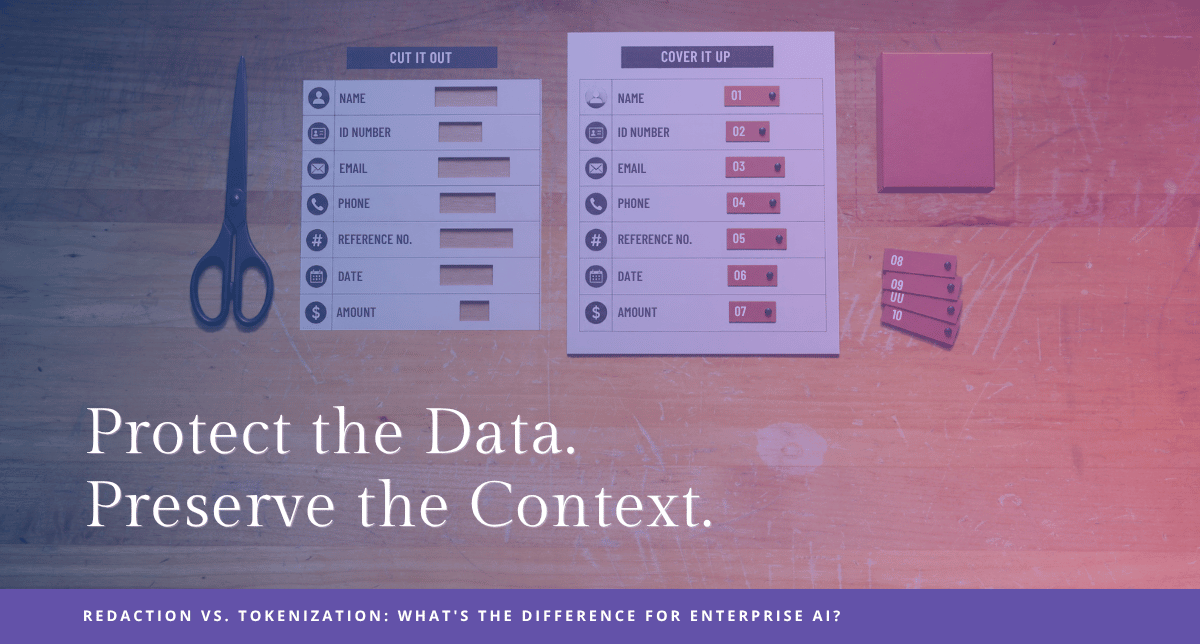
How can organizations protect sensitive information while preserving the context AI needs to produce useful answers?
Redaction and tokenization are two important techniques for protecting sensitive data. Both can reduce exposure of personally identifiable information (PII), but they serve different purposes.
Redaction removes information. Tokenization replaces sensitive values with substitutes that an authorized system can later resolve.
For enterprise AI, this distinction matters. Contracts, financial records, legal documents, and customer communications contain relationships and details that AI systems need to interpret accurately. The way sensitive information is protected can directly affect the usefulness of the results.
Understanding when to redact, mask, or tokenize data is an important part of building secure AI workflows.
Four Techniques for Protecting Sensitive Information
The National Institute of Standards and Technology (NIST) defines de-identification broadly as removing the association between identifying information and the individual it identifies.
Organizations use several techniques to protect information, each with different capabilities and limitations.
1. Redaction: Permanently Remove Sensitive Information
How it works: Redaction removes selected information from a document. Proper electronic redaction removes the underlying content, including relevant text layers and metadata, rather than simply covering it visually.
What AI can still understand: The remaining document content. Depending on how redaction is applied, the model may lose information about relationships between people, organizations, and transactions.
Can the original value be restored? No, not from the properly redacted copy. The original may still exist in a separate source system.
Best used for: Public records, court filings, document production, and information intended for distribution without the removed details.
2. Masking: Conceal Part of a Value
How it works: Masking hides all or part of a sensitive value in a particular view. For example, a customer account number might appear as ****1234.
What AI can still understand: The visible portion, the type of information, and surrounding context.
Can the original value be restored? The masked display alone generally cannot recover hidden characters. An authorized source system may retain the complete value.
Best used for: Customer portals, account statements, support interfaces, and applications that need to display limited information.
3. Tokenization: Replace Sensitive Values with Secure Substitutes
How it works: Tokenization replaces a sensitive value with a substitute, such as PERSON_01 or ACCOUNT_01. In a reversible implementation, an authorized service maintains a secure means of resolving the substitute to its original value.
What AI can still understand: When tokens are assigned consistently, the model can follow relationships between entities, identify repeated references, and interpret events or transactions using the remaining context.
Can the original value be restored? Yes, when the implementation supports detokenization and the requesting system is authorized.
Best used for: Enterprise AI workflows, document analysis, analytics, and applications where sensitive identities must be protected while preserving useful relationships.
4. Format-Preserving Encryption: Protect Values While Maintaining Their Structure
How it works: Format-preserving encryption uses cryptography to produce encrypted values that retain a specified format, such as a fixed-length numeric field.
What AI can still understand: The field’s format and other information left in the surrounding record. The encrypted value itself generally does not preserve the original meaning.
Can the original value be restored? Yes, using the appropriate cryptographic key and decryption process.
Best used for: Legacy applications, structured databases, and systems with strict data-format requirements.
The key distinction: Choose the protection method based on what information the workflow needs to retain, who should have access to original values, and whether those values must be restored.
Why This Matters for Enterprise AI
Consider an organization using AI to review contracts, financial documents, or customer correspondence.
The model may need to determine who owes a payment, who sent a notice, which parties are involved, or whether a particular obligation has been fulfilled.
These tasks depend on relationships between information throughout a document.
A redacted document can still be analyzed, but removing identifiers may make it more difficult to distinguish parties or connect references.
Tokenization can preserve those connections when implemented consistently.
A Practical Example
Imagine an AI system reviewing a services agreement and related correspondence.
Original document
Jordan Sample owes Casey Example $8,400 under a services agreement. Casey Example sent notice on May 2. Jordan Sample responded on May 9, disputing $1,150 of the balance.
After redaction
[REDACTED] owes [REDACTED] $8,400 under a services agreement. [REDACTED] sent notice on May 2. [REDACTED] responded on May 9, disputing $1,150 of the balance.
The model can identify the amounts, dates, and events. However, it cannot reliably determine which redacted references belong to the same individual from this text alone.
After tokenization
PERSON_01 owes PERSON_02 $8,400 under a services agreement. PERSON_02 sent notice on May 2. PERSON_01 responded on May 9, disputing $1,150 of the balance.
The model can now identify that PERSON_02 sent the notice and PERSON_01 owes the balance.
If the application is designed for authorized detokenization, the original names can be restored in the final response through a controlled process.
This example illustrates an important capability: consistent tokens can preserve relationships that would otherwise be lost through generic redaction.
The example is fictional. Actual tokenization systems vary in how they identify sensitive data, generate tokens, maintain mappings, and authorize restoration.
Tokenization Is One Part of a Secure AI Architecture
Tokenization can reduce the exposure of sensitive identifiers, but its effectiveness depends on the broader system design.
Several controls are particularly important.
Accurate sensitive-data detection. A tokenization system must identify the values that need protection. Unstructured documents, including contracts and correspondence, can contain identifiers in unexpected locations.
Protected token mappings. Reversible tokenization requires secure handling of the information or mechanism used to associate tokens with original values. Access should be restricted and monitored.
Consistent token assignment. Where a workflow needs to track the same entity across a document or document set, consistent tokens help preserve relationships.
Controlled restoration. Detokenization should occur only when authorized and necessary for the intended task.
Data minimization. AI systems should receive only the information required to perform their tasks. Even tokenized documents can contain sensitive details or contextual clues that permit re-identification.
Auditability. Organizations should be able to evaluate how sensitive information moves through an AI workflow, including relevant access, processing, and restoration events.
These controls help organizations make deliberate decisions about where sensitive information is processed and who can access it.
What Do Privacy Regulations Say?
Tokenization and pseudonymization are closely related concepts, although they are not interchangeable in every technical or legal context.
Under the European Union’s General Data Protection Regulation (GDPR), pseudonymization involves processing personal data so that it cannot be attributed to a specific person without additional information, which must be kept separately and protected through appropriate safeguards.
Pseudonymized data generally remains subject to data protection requirements when individuals can still be identified through reasonably available additional information. The legal analysis depends on the circumstances and the party processing or receiving the data.
In healthcare, the HIPAA Privacy Rule establishes two methods for de-identifying protected health information: Expert Determination and Safe Harbor.
Safe Harbor generally requires removal of 18 categories of identifiers and the absence of actual knowledge that the remaining information could identify an individual. Expert Determination requires a qualified expert to assess and document a very small risk of identification.
Tokenization alone does not automatically establish HIPAA de-identification or GDPR compliance.
For regulated organizations, privacy protection requires appropriate technical controls, governance, and evaluation of the applicable requirements.
Where Pensato Fits
Enterprise AI systems increasingly need to work with documents containing sensitive information. The challenge is designing workflows that protect that information while preserving the relationships and context required for useful analysis.
Pensato focuses on secure AI for regulated document workflows, with an emphasis on protecting sensitive data, controlling how AI processes information, and supporting traceability.
A tokenization-based approach can help organizations protect direct identifiers before AI processing while retaining the relationships needed for document analysis. Depending on the implementation, authorized systems can restore original values after processing.
The surrounding architecture is equally important. Organizations need to evaluate where inference occurs, how data moves between systems, who can access sensitive values, and what evidence is available to review AI activity.
These considerations are especially relevant in mortgage and lending, legal services, financial services, and other industries that handle sensitive documents at scale.
Protect the Data. Preserve the Context. Control the Workflow.
Redaction, masking, tokenization, and encryption each have a role in enterprise data protection. The right approach depends on the intended use of the information, the sensitivity of the data, and the controls surrounding the AI system.
For organizations moving AI into production, these decisions belong in the architecture from the beginning.
Is your AI workflow exposing more sensitive information than it needs to? Pensato helps organizations evaluate secure AI architectures for regulated document workflows, including how sensitive data is protected, processed, and traced.
Talk with Pensato about securing your enterprise AI workflows
Learn how to protect sensitive information while giving AI the context it needs to deliver useful results.